
A mystery reader already knows how to follow a disappearance. A historical fiction reader knows how to get their bearings in another century. Those habits can take you somewhere new. Keala Kendall turns a missing-person search into Hawaiian Gothic horror, while Vicente Luis Mora starts with a burial and digs up soldiers from wars that haven’t happened yet.
I picked one finalist from each of the five 2026 National Book Award categories. The best place to start is the book that gives you something familiar to follow, whether that’s a family relationship, an unsettling setting or an image you can’t stop thinking about. The winners will be announced November 18. See the National Book Foundation’s announcement and our complete guide to the 2026 National Book Award finalists.
| If you usually read… | Try… | What carries over |
|---|---|---|
| Historical fiction | Centroeuropa by Vicente Luis Mora | The way a place holds the history of war |
| Missing-person mysteries | That Which Feeds Us by Keala Kendall | A disappearance in an isolated setting |
| Books about art | Tree of Knowledge by Victoria Chang | The pleasure of looking closely at an image |
| Family novels | Mother Tongue by Sara Nović | The questions families face across generations |
| Psychological suspense | Dèy by Edwidge Danticat | The tension of keeping a secret |
As an Amazon Associate I earn from qualifying purchases.
1. Try Centroeuropa if you read historical fiction

Vicente Luis Mora, translated from Spanish by Rahul Bery · Translated Literature finalist
In the early nineteenth century, a widower digging a grave for his wife finds a frozen Prussian soldier. The ground yields more bodies, including soldiers from conflicts still in the future. The grave gives the novel a fixed point even as the history around it refuses to stay in order.
I’d start here if you like historical fiction that shows how wars linger in the places where people live. The pleasure is seeing what happens when a novelist makes that idea literal. Read the opening for the matter-of-fact way the widower describes a discovery that should be impossible.
2. Try That Which Feeds Us if you read missing-person mysteries

Keala Kendall · Young People’s Literature finalist
A Native Hawaiian teenager searches for her missing twin at an isolated luxury resort. The seclusion that guests are paying for makes it harder for her to find answers. And the longer she looks, the more the resort’s ghosts and Hawai‘i’s history intrude on the story the property sells its visitors.
This is the easiest jump for readers who already like mysteries set in hotels or on islands. You have a concrete question to follow from page one. The genre shift comes when the setting starts to matter as much as the disappearance, and the history of the land helps explain why the resort is such an unsettling place.
Find That Which Feeds Us on Amazon!
3. Try Tree of Knowledge if you read about art

Victoria Chang · Poetry finalist
Workers saw branches from a eucalyptus on Chang’s street. The tree returns throughout the collection, taking on different associations as Chang looks at work by artists including Joan Mitchell, Pablo Picasso and Hilma af Klint.
Give the publisher’s excerpt ten minutes. Follow the tree from one poem to the next and see what changes when it appears beside a different image. It’s the same kind of attention you give a painting when you step back and notice that a detail you thought was incidental changes the whole composition. For another way into the form, see our guide to where to start with Anne Carson.
Find Tree of Knowledge on Amazon!
4. Try Mother Tongue if you read family novels
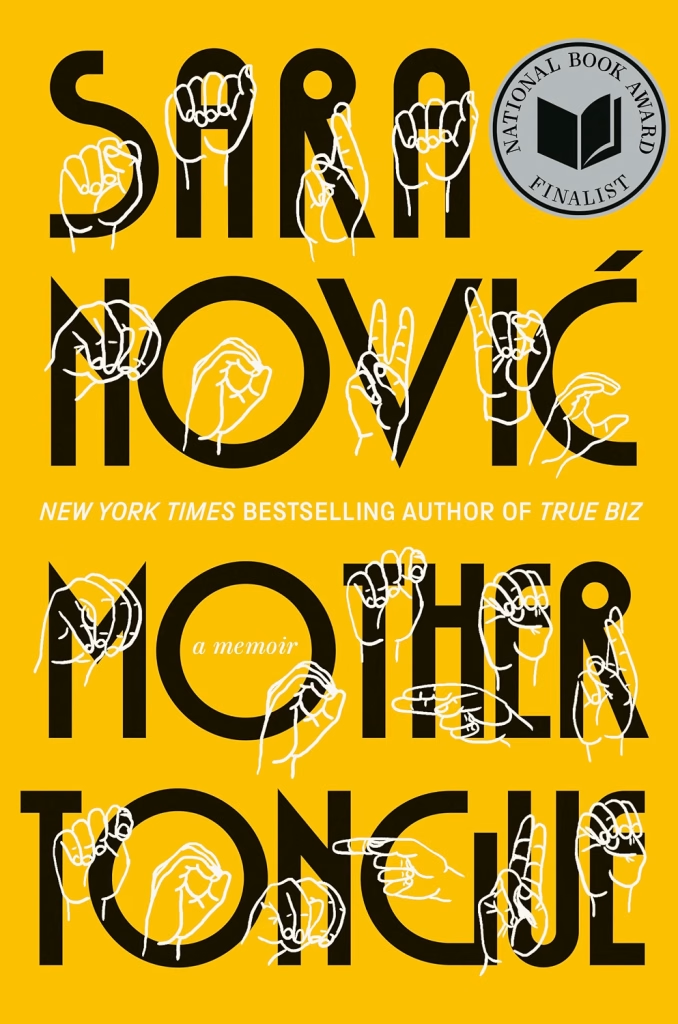
Sara Nović · Nonfiction finalist
In her memoir, the author of True Biz writes about finding her place in the Deaf community and what it means to raise children whose experiences differ from her own. Language connects the two parts of that story. It’s how she finds community and part of what she considers passing on to her children.
I’d choose this for readers who look for the family scenes in a novel, especially the ones where two generations think they understand each other and discover how much they’ve assumed. Here, everyday choices about communication open up larger questions about belonging.
Find Sara Nović’s hardcover memoir on Amazon.
5. Try Dèy if you read psychological suspense

Edwidge Danticat · Fiction finalist
Magnolia, a Haitian American real estate agent, takes shelter during a shooting at a Miami mall. When she goes home, she keeps the experience to herself. The novel follows the pressure of that decision as her life and memories take the story between Miami, Brooklyn and Haiti.
If your favorite part of suspense is watching what happens after someone withholds a crucial fact, this is the literary novel I’d hand you. Even an ordinary conversation can carry tension when you know what Magnolia has left out. The question worth following is whom she feels able to tell and what that reveals about the people she trusts.
Which book should you start with?
Pick That Which Feeds Us if you want the quickest pull into a new genre. The missing-twin premise gives you a question you’ll want answered even if you rarely read horror. For a bigger change in how you read, open the Tree of Knowledgeexcerpt and spend a few minutes with one poem. For historical fiction fans, the frozen soldier in Centroeuropa is the opening I’d try first.
Follow us on Instagram and Facebook


Discover more from Books of Brilliance
Subscribe to get the latest posts sent to your email.
