
Fantasy and science fiction can take us anywhere. Yet even stories about impossible worlds often follow familiar patterns: a central hero, a clear timeline, and a narrator who helps us understand what is happening.
These experimental fantasy and science-fiction novels challenge those expectations. Some scramble chronology. Others turn the narrator into a mystery, replace a conventional plot with an imaginary cultural archive, or make the language itself obey increasingly restrictive rules.
“Break every storytelling rule” is a playful description, rather than a literal claim. What connects these books is that their unusual forms matter to their stories. The experiment changes how we experience memory, identity, power, or an unfamiliar world.
Fantasy is my favorite genre, and the Broken Earth trilogy is one of my favorite reading experiences. It is also a reminder of how much a fantasy novel can accomplish when its storytelling feels as ambitious as its worldbuilding.
This list focuses on narrative invention rather than simply strange premises. It includes fantasy, science fiction, and books that cross into speculative literary fiction. The selections are unranked, and the descriptions avoid major twists.
1. The Fifth Season by N. K. Jemisin

The convention it challenges: A narrator should keep a comfortable distance from the reader.
The Fifth Season opens the Broken Earth trilogy, introducing a world threatened by catastrophic geological upheaval and a society that exploits people with the power to control the earth.
Jemisin combines different narrative strands with striking second-person passages. The use of “you” gives the writing an intimacy that can also feel unsettling: the reader occupies an experience before fully understanding its context.
Its structure makes rereading particularly rewarding. Information that initially seems disconnected acquires new meaning, and the relationship between form and character becomes increasingly important.
Best for: Fantasy readers who want emotional intensity alongside ambitious worldbuilding. Start here before The Obelisk Gate and The Stone Sky.
2. The Spear Cuts Through Water by Simon Jimenez

The convention it challenges: A scene should belong to one stable point of view.
At the heart of The Spear Cuts Through Water is a journey involving two young men, an escaped god, and an oppressive empire. Around that adventure, Jimenez builds layers of remembered stories, theatrical performance, and shifting voices.
The narration moves among first, second, and third person. Brief voices interrupt the main action, giving people at the edges of the adventure a presence that a more conventional epic might deny them.
The effect is closer to witnessing a story being performed and passed down than following an invisible narrator. Its complexity asks for concentration, but the central journey provides a thread to follow.
Best for: Readers drawn to myth, oral storytelling, and fantasy with an emotionally charged adventure at its center.
3. Piranesi by Susanna Clarke

The convention it challenges: The narrator should understand the world before explaining it.
In Piranesi, an immense House filled with statues, halls, and tides becomes the setting for a quietly disorienting mystery.
Clarke tells the story through the narrator’s journals. His observations are meticulous, but the framework through which he interprets them is something the reader must gradually examine.
That creates a fascinating gap between recording information and understanding it. The book invites us to pay attention to what the narrator notices, what he takes for granted, and what his records might reveal beyond his intentions.
It is one of the gentler entry points on this list: compact, atmospheric, and anchored by a distinctive voice.
Best for: Readers who want a strange fantasy world without committing to a lengthy series. Read it as a standalone.
4. The Raven Tower by Ann Leckie

The convention it challenges: Human characters should control the telling of their own story.
The Raven Tower combines a political succession crisis with a narrator whose perspective extends far beyond a human lifetime.
A god associated with a stone addresses the human Eolo as “you,” while recounting its own history. Human urgency and divine patience sit beside each other, making familiar struggles over power look different when viewed across immense stretches of time.
Language also has material consequences for the gods. Statements can affect reality, so precision becomes part of the novel’s magic and its suspense.
The unusual narration asks the reader to consider who is speaking, whom they are addressing, and what their attention leaves outside the frame.
Best for: Readers interested in divine perspectives, political mysteries, and carefully constructed fantasy. This is a standalone.
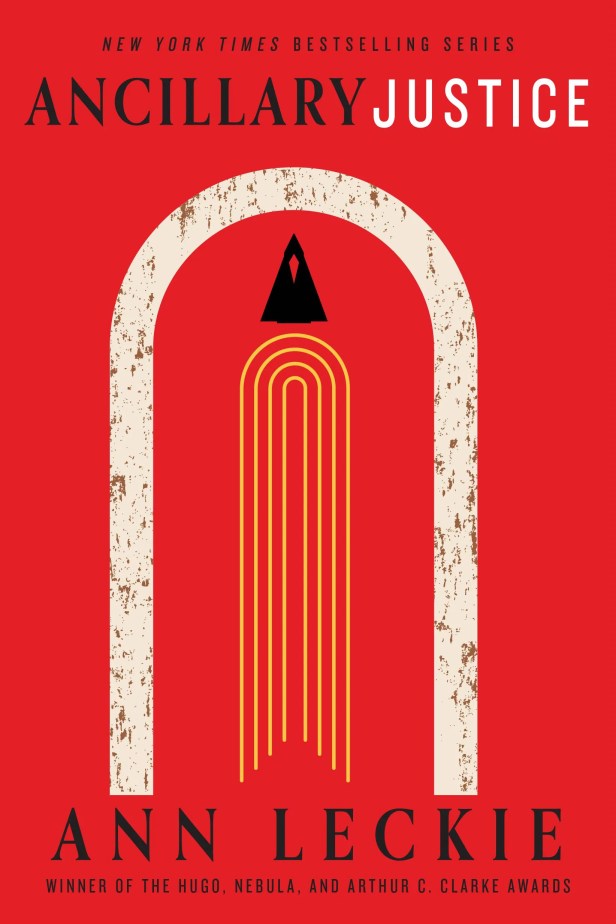
5. Ancillary Justice by Ann Leckie
The convention it challenges: One narrator means one body and one viewpoint.
The protagonist of Ancillary Justice, Breq, was once part of a starship intelligence operating through many human bodies. Now she is confined to one.
That history allows Leckie to experiment with a consciousness whose memories include simultaneous experiences. A seemingly individual voice carries the traces of a much larger self.
The novel also unsettles the reader’s assumptions through pronouns. As Leckie explains in her FAQ, the use of “she” represents a translation convention for a language that does not mark gender in personal pronouns.
Identity becomes something the reader must actively think through, rather than a collection of labels supplied by the narration.
Best for: Science-fiction readers interested in artificial intelligence, empire, and unfamiliar ways of perceiving people. It begins the Imperial Radch trilogy.
Buy book on Amazon
6. Harrow the Ninth by Tamsyn Muir

The convention it challenges: A sequel should clarify what the previous book established.
Harrow the Ninth is the second Locked Tomb novel, following a necromancer whose circumstances and perceptions are increasingly difficult to trust.
Muir uses second-person narration, fractured recollections, and apparent contradictions to turn the reading experience into an investigation. Knowing the previous book can make the discrepancies more disturbing rather than immediately easier to explain.
Its shifts in voice and structure carry narrative significance. Explaining too much about why would spoil the experience, so the best advice is to notice inconsistencies and keep reading.
Best for: Readers who enjoy demanding mysteries, gothic science fantasy, and books that invite rereading. Read Gideon the Ninth first; Harrow is not a standalone starting point.
7. Use of Weapons by Iain M. Banks

The convention it challenges: A character’s past should unfold toward the present.
In Use of Weapons, Banks follows Cheradenine Zakalwe, an operative recruited to intervene in the affairs of other civilizations on behalf of the Culture.
Two interwoven narrative sequences move in opposing directions. One advances through a mission, while the other travels backward through the protagonist’s history.
The arrangement changes how the reader judges the character. We encounter consequences before their origins, and each return to the past can revise our understanding of the present.
Its structure makes chronology an instrument of revelation. Reordering the events into a straightforward timeline would change the emotional experience of the book.
Best for: Readers who like morally difficult space opera and nonlinear character studies. It can be read independently within the Culture series.
8. Cloud Atlas by David Mitchell

The convention it challenges: Finish one story before beginning another.
Cloud Atlas contains six connected narratives that move from historical settings into speculative futures.
Most are interrupted before completion. After reaching the central narrative, the novel returns through the earlier stories in reverse order, creating a nested structure.
Mitchell changes voice and form along the way, moving through journals, letters, a thriller, and other modes of storytelling. Connections emerge through documents, recurring patterns, and the ways people use or resist power.
The book crosses genres rather than remaining science fiction throughout. Its speculative sections gain resonance from the histories and habits that precede them.
Best for: Readers who enjoy literary fiction, varied voices, and stories whose connections become clearer over time.
9. Always Coming Home by Ursula K. Le Guin

The convention it challenges: A novel needs a single plot to hold its world together.
Always Coming Home imagines the Kesh, a people living in a future Northern California, through a collection of cultural materials.
Stone Telling’s narrative sits alongside poems, tales, plays, recipes, and language materials. The book resembles an archive of a society, with a personal story woven into its larger texture.
Le Guin gives everyday customs and communal life a degree of attention that adventure narratives often reserve for conflict. Worldbuilding becomes the form of the book itself.
This is a novel that stretches the category almost to its limits. Its appeal lies partly in exploring a culture rather than hurrying toward a final confrontation.
Best for: Readers who love anthropology, imagined societies, and fiction they can explore at a reflective pace.
10. Dhalgren by Samuel R. Delany

The convention it challenges: An unexplained disaster should eventually receive a definitive explanation.
Dhalgren follows a young man through Bellona, an American city where ordinary reality has become unstable.
Delany makes uncertainty part of the book’s construction. Memory, identity, time, and the relationship between writing and experience resist easy organization. Notebook material and fragmented passages complicate the idea of a single authoritative account.
This is among the most demanding selections here. Readers looking for a tidy explanation of the city may find it frustrating; readers interested in atmosphere, sexuality, social life, and unstable perception have much more to explore.
Best for: Readers ready for a long, explicit, ambiguous work of experimental speculative fiction.
11. The City & The City by China Miéville

The convention it challenges: A detective should describe everything in plain sight.
The City & The City follows a murder investigation involving two cities that overlap physically while remaining socially and politically separate.
Their inhabitants are trained to disregard the other city. That makes observation, normally the detective’s greatest advantage, subject to extraordinary restrictions.
This is a subtler formal experiment than Dhalgren or Always Coming Home. Much of its power comes from making a familiar police procedural operate through a profoundly unfamiliar system of attention.
The reader must learn which details can be acknowledged and how a place can be present while officially absent. The narration teaches those rules gradually.
Best for: Mystery readers looking for a bridge into weird and speculative fiction. This is a standalone.
12. Ella Minnow Pea by Mark Dunn

The convention it challenges: A novelist can use any letters the story needs.
In Ella Minnow Pea, the residents of an imaginary island face increasingly restrictive laws banning letters of the alphabet.
The novel is told through correspondence, and the writing itself reflects those restrictions as letters disappear from use. Its technique is called a progressive lipogram: a work that excludes particular letters, with the constraint becoming more severe as the story continues.
The result is both a linguistic puzzle and a satire of authoritarianism. Censorship damages the characters’ ability to communicate, and readers encounter that damage directly in the prose.
Best for: Readers who enjoy wordplay, compact dystopian fables, and experiments with an immediately understandable premise.
Which Experimental Novel Should You Read First?
For an approachable standalone, start with Piranesi. For an experiment you can see unfolding in the language, try Ella Minnow Pea. If you want substantial fantasy worldbuilding with structural surprises, choose The Fifth Season.
Readers who already enjoy nonlinear fiction can move toward Use of Weapons or Cloud Atlas. For the most radical departures from conventional plot and narration, consider Always Coming Home and Dhalgren.
The question worth asking is what kind of uncertainty you enjoy. You might love piecing together a timeline but dislike an ending that leaves questions open. You might prefer a strange narrator to a book built like an archive. Matching the experiment to your tastes makes these novels far more rewarding.
Which fantasy or science-fiction novel changed your idea of how a story could be told?
Follow us on Instagram and Facebook


Discover more from Books of Brilliance
Subscribe to get the latest posts sent to your email.

Excellent list. I’ll have to add a few of these to my To Read list. Thanks. 🤣😎🙃