
Some science-fiction novels take you to another planet. Others make you question whether the chapter you just finished happened before the one you are about to read.
The best nonlinear science-fiction novels include Slaughterhouse-Five, Use of Weapons, The Dispossessed and The Light Brigade. These books rearrange events through fractured memories, alternating timelines, nested narratives or time travel that makes cause and effect difficult to separate.
I love time-travel stories, but the appeal of an out-of-order novel goes beyond the mechanics. A scene can change meaning when you finally learn what happened before it. A character you thought you understood can become someone entirely different without the author changing a single earlier sentence.
For this list, chronology has to shape the reading experience. The selections range from space opera to literary science fiction, with crossover works that also draw on romance, historical fiction and post-apocalyptic storytelling. The descriptions explain their structures without revealing their biggest twists.
If you enjoy experiments beyond chronology, explore our experimental fantasy and science-fiction novels for more unusual approaches to storytelling.
Disclosure: As an Amazon Associate, I earn from qualifying purchases.
The Books at a Glance
| Novel | Author | How it rearranges the story |
|---|---|---|
| Slaughterhouse-Five | Kurt Vonnegut | Jumps among moments in one man’s life |
| Use of Weapons | Iain M. Banks | Interleaves forward and backward narrative strands |
| The Dispossessed | Ursula K. Le Guin | Alternates an adult journey with an earlier life |
| The Time Traveler’s Wife | Audrey Niffenegger | Combines two perspectives with mismatched personal timelines |
| Cloud Atlas | David Mitchell | Interrupts stories, then returns through them in reverse |
| Hyperion | Dan Simmons | Embeds accounts of the past within a pilgrimage |
| Ancillary Justice | Ann Leckie | Alternates a present quest with an AI’s earlier experiences |
| The Light Brigade | Kameron Hurley | Presents a war in the order a time-displaced soldier experiences it |
| Station Eleven | Emily St. John Mandel | Moves between life before and after a pandemic |
| Sea of Tranquility | Emily St. John Mandel | Revisits connected events across centuries |
| Oryx and Crake | Margaret Atwood | Reconstructs a catastrophe through memories |
| Version Control | Dexter Palmer | Revisits lives through altered versions of their history |
1. Slaughterhouse-Five by Kurt Vonnegut

Billy Pilgrim does not experience his life as a steady march from childhood to old age. In Slaughterhouse-Five, moments from war, civilian life and encounters with aliens arrive in a fractured sequence.
That structure gives the novel its emotional force. Dresden is not a chapter Billy can finish and leave behind. The past keeps returning, interrupting any reassuring sense that survival means an experience is over.
The time jumps can be read alongside the novel’s treatment of trauma, fatalism and free will. Its relatively compact length makes it a useful starting point for readers curious about nonlinear fiction.
Best for: Readers who want an antiwar classic with dark humor and a deeply unsettled relationship to time.
2. Use of Weapons by Iain M. Banks

Use of Weapons follows Cheradenine Zakalwe, an operative whose abilities make him useful to the Culture. His past, however, is essential to understanding the person doing the work.
Banks interleaves one strand that advances with another that moves backward through earlier events. The reader keeps progressing toward an explanation while also retreating toward its origins.
What makes the arrangement effective is its control over judgment. You see actions before receiving all the information needed to interpret them. Later revelations ask you to reconsider what you accepted earlier.
Best for: Readers who enjoy morally difficult space opera and demanding narrative puzzles.
3. The Dispossessed by Ursula K. Le Guin

In The Dispossessed, physicist Shevek travels from the anarchist society of Anarres to the wealthy world of Urras. Le Guin alternates that journey with the earlier experiences that shaped his life on Anarres.
The two strands make comparison unavoidable. Just as one society begins to appear attractive, the other timeline complicates your assumptions about freedom, work, property and belonging.
This is an excellent reminder that nonlinear storytelling does not require a time machine. Here, the arrangement of chapters becomes part of a political and philosophical argument.
Best for: Readers who prefer ideas, social questions and character development to constant action.
4. The Time Traveler’s Wife by Audrey Niffenegger

Henry and Clare share a relationship without sharing the same experience of its sequence. Henry’s involuntary time travel means an encounter can be familiar to one person and entirely new to the other.
Audrey Niffenegger has described the time travel as a way of examining a marriage from a fragmented perspective. The novel combines Henry’s and Clare’s viewpoints, with dates and ages helping readers track their unequal knowledge.
The result blends science-fiction premises with a relationship novel. Waiting, recognition and absence become questions of chronology as well as intimacy.
Best for: Readers who want an emotional time-travel story centered on love and its complications.
5. Cloud Atlas by David Mitchell

Cloud Atlas travels from the nineteenth century into distant futures, shifting voice and genre along the way.
Its famous arrangement interrupts the first five narratives, reaches a complete central story, then returns through the interrupted narratives in reverse order. It is a nested structure rather than a single plot shuffled at random.
The historical sections matter as much as the futuristic ones. Patterns of exploitation, resistance and storytelling recur across settings, encouraging readers to notice connections that a straightforward timeline might obscure.
Best for: Readers who enjoy literary ambition, changing voices and stories that reward attention to echoes.
6. Hyperion by Dan Simmons

Seven pilgrims journey toward a mysterious destination in Hyperion. As they travel, their accounts of earlier experiences gradually reshape the meaning of the expedition.
Its principal device is a frame narrative: the journey contains stories that reach backward into different lives. Those accounts also bring different tones, including horror, military science fiction and detective fiction.
Rather than experiencing the relevant events as one chronological history, readers assemble their significance through testimony. The Time Tombs add another layer of temporal unease.
This is the opening novel of a larger story; The Fall of Hyperion continues it.
Best for: Readers who want a substantial space opera built from interconnected personal histories.
7. Ancillary Justice by Ann Leckie
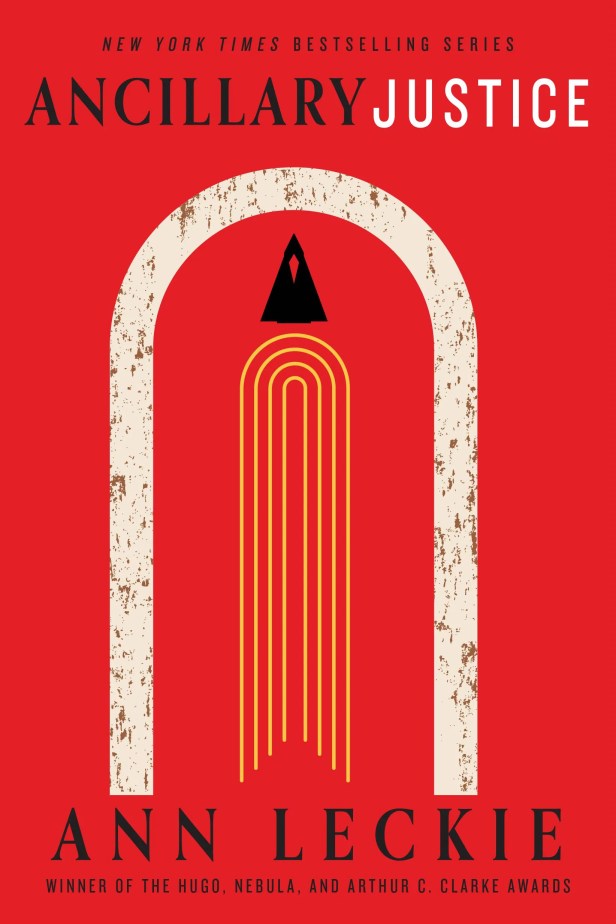
The protagonist of Ancillary Justice was once part of a starship intelligence distributed across many bodies. Now Breq has one human body and a purpose rooted in what happened before.
Leckie alternates the present quest with earlier events, allowing the reader to discover how that radical change occurred. The contrast between a distributed consciousness and an isolated individual makes the temporal shifts especially interesting.
Past and present reveal different capacities, relationships and forms of power. Understanding Breq means understanding both versions of that existence.
Best for: Readers interested in artificial intelligence, imperial politics and unconventional perspectives.
8. The Light Brigade by Kameron Hurley

In The Light Brigade, soldiers are converted into light for transportation to distant battlefields. Dietz begins experiencing deployments that do not match the sequence experienced by other soldiers.
The novel follows Dietz’s encounters with the war, leaving readers to reconstruct the larger chronology. Mission briefings and personal experience become difficult to reconcile.
Its structure connects confusion about time with confusion about authority. If your experience contradicts the official account, deciding which version to trust becomes a matter of survival.
Best for: Readers who enjoy fierce military science fiction, time-travel puzzles and criticism of corporate power.
9. Station Eleven by Emily St. John Mandel

Station Eleven moves between the world before a devastating pandemic and the lives of survivors afterward.
Its nonlinear structure reveals connections among people, objects and memories gradually. A detail encountered in the ruined world can acquire emotional weight when the novel returns to the life it belonged to before.
This is a post-apocalyptic literary crossover rather than a technology-focused adventure. Its interest lies in what people carry forward: art, affection, regret and incomplete knowledge of one another.
Best for: Readers who want an accessible nonlinear novel about memory, culture and survival.
10. Sea of Tranquility by Emily St. John Mandel

Sea of Tranquility connects lives across centuries, from early twentieth-century Earth to future lunar settlements.
The opening sections introduce separated periods, but the novel later revisits those events through a time-travel investigation. What first appears incidental becomes part of a larger question about reality.
Its strength is the balance between scale and intimacy. The scientific mystery matters, yet so do the ordinary experiences of loneliness, artistic work and wanting to return home.
Best for: Readers seeking a relatively short novel that combines a temporal mystery with literary warmth.
11. Oryx and Crake by Margaret Atwood

Oryx and Crake begins with Snowman struggling in a world already transformed by catastrophe. Memories of his earlier life as Jimmy gradually reveal the path toward that aftermath.
Atwood alternates survival with recollection, allowing consequences to appear before their causes are fully understood. The earlier world of corporations, genetic engineering and damaged relationships becomes increasingly disturbing because readers already know something terrible lies ahead.
The central tension comes from discovering how private choices and powerful institutions contributed to the world Snowman inhabits.
Best for: Readers who enjoy biotechnology, dystopia and a slow reconstruction of disaster.
12. Version Control by Dexter Palmer

Version Control follows Rebecca Wright, whose husband works on a device intended to violate causality.
Palmer initially grounds the story in marriage, grief, technology and ordinary social life. As the novel develops, altered versions of events challenge the stability of that familiar history.
This is a different kind of temporal experiment from chapters moving steadily backward. The book revisits lives through changes to their past, making comparison between versions central to the reading experience.
Best for: Readers willing to spend time with a patient literary novel before its science-fiction implications fully emerge.
Which Nonlinear Science-Fiction Novel Should You Read First?
Start with Slaughterhouse-Five for a compact classic, Station Eleven for an emotionally accessible ensemble story, or Sea of Tranquility for a shorter time-travel mystery.
If you want a more demanding challenge, choose Use of Weapons. For political and philosophical depth, try The Dispossessed. For a story whose chronology is tangled up with battlefield survival, pick The Light Brigade.
Read each book in the order its author presents it. A chronological guide can be useful afterward, but consulting one too early may reveal exactly the information the structure was designed to withhold.
Which science-fiction novel made you rethink everything you had already read? Share your pick in the comments.
Follow us on Instagram and Facebook


Discover more from Books of Brilliance
Subscribe to get the latest posts sent to your email.
