By Books of Brilliance | Updated September 28, 2026
Finishing N. K. Jemisin’s Broken Earth trilogy can leave you wanting a very particular kind of book. The Fifth Season, The Obelisk Gate, and The Stone Sky offer a world shaped by catastrophe, a power system inseparable from oppression, and a family story with consequences for everyone around it. Even the way Jemisin tells the story challenges your assumptions about what you know.
I consider The Broken Earth one of the best fantasy trilogies I’ve read. Its scale matters, but what stays with me is how the enormous ideas remain tied to people making painful choices. The books below were chosen for a specific overlap: inventive worlds, power and its costs, unusual storytelling, or the uneasy boundary between fantasy and science fiction. They are spoiler-free recommendations, not promises of another Stillness.
Where should you start?
| What you want after The Broken Earth | Try first |
|---|---|
| More Jemisin and gods entangled with human power | The Hundred Thousand Kingdoms |
| Colonialism examined through a character’s choices | The Unbroken or The Traitor Baru Cormorant |
| A world with unfamiliar religion and magic | The Jasmine Throne or Black Sun |
| Bold narrative form | The Spear Cuts Through Water |
| Planetary change and long time scales | Children of Time |
1. The Hundred Thousand Kingdoms by N. K. Jemisin

Best for: Readers who want Jemisin’s interest in who controls divine power.
Yeine Darr arrives at the royal court and finds herself caught in a succession struggle with relatives she barely knows. The gods are part of that struggle, too, and the rules of their captivity reveal how this world works. It is the first book in Jemisin’s Inheritance Trilogy.
The immediate attraction is Jemisin’s willingness to build a society around an injustice and then ask what it would take to change it. Expect a more court-centered story with gods, inheritance, and family secrets. The scale and structure differ from The Broken Earth, but her curiosity about power is already unmistakable.
2. The Unbroken by C. L. Clark
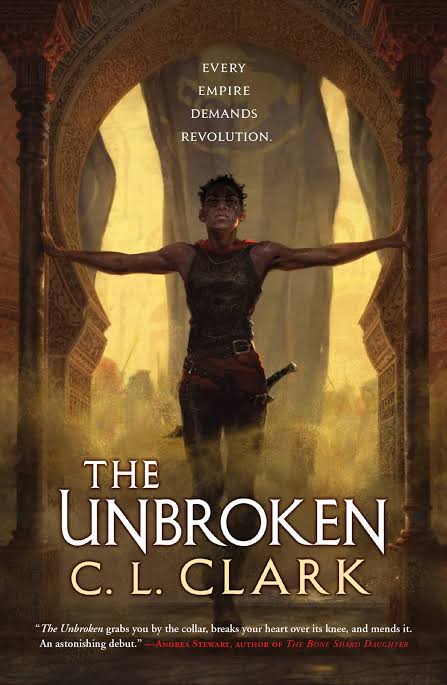
Best for: The political conflict and the question of where someone belongs.
Touraine was taken from her homeland and trained as a soldier for the empire that conquered it. Returning to that homeland brings her into contact with people resisting imperial rule, while Luca, an imperial princess, has her own reasons to seek Touraine’s help.
This is an excellent next choice if what gripped you about The Broken Earth was the damage a system does to people forced to live within it. Clark makes allegiance personal: Touraine cannot make a clean choice simply by deciding which side is right. This is military and political fantasy with a closer focus on occupation than on geological apocalypse.
3. The Jasmine Throne by Tasha Suri

Best for: Forbidden power, empire, and women refusing assigned roles.
A captive princess and a maidservant with dangerous, forbidden magic become unlikely allies in the first book of The Burning Kingdoms trilogy. Their bond grows within a larger struggle over faith, imperial power, and who gets to shape the future.
If you loved seeing Jemisin’s characters test the limits of the roles imposed on them, Suri offers another richly imagined world where private decisions carry public consequences. The story has a stronger romantic thread and a different, more lushly mythic atmosphere.
4. Black Sun by Rebecca Roanhorse

Best for: A fully imagined setting, prophecy, and competing viewpoints.
The first volume of the Between Earth and Sky trilogy draws inspiration from civilizations of the pre-Columbian Americas. Its story brings together celestial prophecy, political conflict, and forbidden magic as several characters move toward a consequential convergence.
Like The Broken Earth, Black Sun asks you to learn the logic of its world as the characters reveal it. Religious authority and social hierarchy are part of the machinery of the plot. Start here if you want another sweeping trilogy, though Roanhorse’s mythic, celestial focus creates a markedly different feel.
5. The Traitor Baru Cormorant by Seth Dickinson

Best for: A ruthless examination of empire and what resistance can cost.
Baru comes from a people conquered by the Empire of Masks. Rather than attack it from outside, she tries to gain power within its institutions and use that power to change what happened to her home.
This is perhaps the sharpest match for readers fascinated by the systems behind Jemisin’s story. Dickinson concentrates on economics, administration, and coercion: tools that can harm whole populations without a single spectacular magical act. It is emotionally severe and more geopolitical than elemental, so choose it when you are ready for difficult moral compromises.
6. The Spear Cuts Through Water by Simon Jimenez

Best for: Readers who admired The Broken Earth’s daring storytelling.
Jun and Keema escort an ancient god across a fractured land in a bid to end the Moon Throne’s tyranny. Their journey is told through a striking frame that turns the act of hearing and passing on a story into part of the experience.
Jemisin trusts readers to find their footing in a story with unusual perspective. Jimenez asks for a similar openness, though his book is a standalone shaped like a mythic journey rather than a trilogy about a world’s recurring disasters. If inventive form was your favorite part of The Fifth Season, put this near the top.
7. The Saint of Bright Doors by Vajra Chandrasekera

Best for: Strange worldbuilding and questions about belief.
Fetter grows up under the weight of his mother’s extraordinary plans for him, then tries to make a life outside the destiny she has prescribed. The city around him holds mysterious doors and competing ideas about the sacred, the ordinary, and who can move freely between them.
This novel rewards the same readerly curiosity The Broken Earth demands: apparent oddities gradually suggest a deeper social order. Its focus is more urban, surreal, and inward-looking. Come for a book interested in who gets called a savior, who is shut out, and how a society tells its own history.
8. A Memory Called Empire by Arkady Martine

Best for: The relationship between identity, memory, and imperial power.
New ambassador Mahit Dzmare arrives at the heart of a vast empire and must investigate the death of her predecessor while navigating a political crisis. She is drawn to the empire’s culture even as its expansion threatens her home.
This one is science fiction, but it belongs on the list for readers who loved Jemisin’s big questions: How do institutions shape what people remember? What does it mean to admire a culture that could erase yours? The setting is interstellar diplomacy, with mystery driving the plot instead of earthquakes and magic.
9. The Left Hand of Darkness by Ursula K. Le Guin

Best for: Speculative fiction that uses an unfamiliar society to rethink familiar assumptions.
An envoy travels to the planet Winter, hoping to bring its people into a larger alliance. The society he encounters challenges his assumptions about gender, politics, and trust.
Le Guin’s novel is a classic of science fiction, not a close match in plot or pace. Its connection to The Broken Earth lies in its method: build a coherent world, then use the distance from our own to make readers question what they thought was natural. If you loved the intellectual work Jemisin asks of you, this is essential reading.
10. Children of Time by Adrian Tchaikovsky

Best for: A planet-sized premise and change unfolding across generations.
Humanity’s survival becomes tied to a terraformed world whose development does not go according to plan. Tchaikovsky follows the consequences over a vast span of time, asking who might inherit a world and what intelligence can look like.
This is the most science-focused recommendation here. It does not reproduce the intimate family story at the heart of Jemisin’s trilogy, but it delivers that exhilarating feeling of seeing a whole world change as its inhabitants struggle to survive. Choose it if the ecological scale and long history of the Stillness were what you found most absorbing.
Which book is closest to The Broken Earth Trilogy?
There is no exact substitute. For the same author’s treatment of gods and unequal power, begin with The Hundred Thousand Kingdoms. For oppression and the terrible cost of trying to change a system, pick The Traitor Baru Cormorant or The Unbroken. For an ambitious narrative voice, try The Spear Cuts Through Water. And if you are willing to cross into science fiction for another enormous thought experiment, choose Children of Time.
What made The Broken Earth unforgettable for you: the characters, the world, or the way its revelations changed everything you thought you knew? That answer is probably the best guide to your next read.
Follow us on Instagram and Facebook
Posts


Discover more from Books of Brilliance
Subscribe to get the latest posts sent to your email.