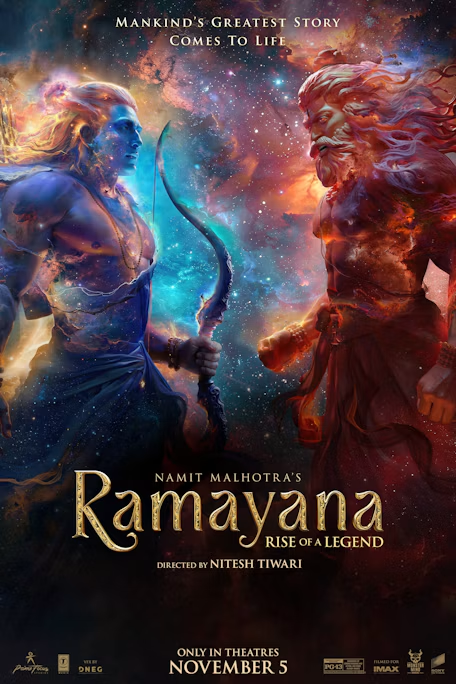
If Ramayana: Rise of a Legend left you wanting to read the epic, start with Arshia Sattar’s Valmiki’s Ramayana. Her abridged translation is the best all-around choice for a first encounter with Valmiki’s Sanskrit telling in English. For a shorter read, choose R. K. Narayan’s The Ramayana, a prose retelling that draws on the Tamil poet Kamban. If you want to read the full text of the Sanskrit Critical Edition in English, choose Bibek Debroy’s three-volume The Valmiki Ramayana.
Nitesh Tiwari’s film opened in theaters November 5, 2026, and stars Ranbir Kapoor, Sai Pallavi and Yash. Sony describes it as an adaptation of the ancient epic. That epic lives in many literary, devotional and performance traditions, and the three books below offer two different ways into it: through Valmiki’s Sanskrit telling or through Narayan’s retelling of a Tamil telling. This guide keeps the film’s ending unspoiled.
As an Amazon Associate I earn from qualifying purchases.
Three English editions at a glance
| Edition | What you’re reading | Length of the edition shown | Best for |
|---|---|---|---|
| R. K. Narayan, The Ramayana | Short English prose retelling drawing on Kamban’s Tamil poem | 192 pages | A quick first read |
| Arshia Sattar, Valmiki’s Ramayana | Abridged English translation from Sanskrit | 574 pages | A substantial first read of Valmiki |
| Bibek Debroy, The Valmiki Ramayana | Unabridged English translation of the Sanskrit Critical Edition | 1,440 pages across three volumes | Reading the Critical Edition in full |
R. K. Narayan’s The Ramayana is the quickest way into the story
Choose Narayan if you came out of the theater wanting to follow Rama, Sita and Ravana through the larger story without committing to a long epic. His version reads as a compact work of English prose. The Penguin Classics paperback, with an introduction by Pankaj Mishra, comes in at 192 pages.
The detail to know before buying is that Narayan draws on Kamban’s Tamil poem. If you eventually read Sattar or Debroy, you’ll be moving between traditions as well as between writers. That makes Narayan a worthwhile first read even if you plan to read Valmiki later. You’ll already have a feel for the broad story, and you can pay closer attention to where the tellings put their emphasis.
Find R. K. Narayan’s Penguin Classics paperback on Amazon
Arshia Sattar’s Valmiki’s Ramayana is the best first choice for most readers
Choose Sattar if the movie made you curious about the decisions behind the action. Rama’s exile, for example, is also a family crisis about promises and obligations. This edition gives you room to follow those tensions while keeping the Sanskrit epic to a single book. The 2019 HarperCollins India edition runs to 574 pages.
Sattar’s account of her approach also tells you what you’re getting. She made choices about what to keep when she abridged the epic, so there’s a difference between the scope of her translation and Debroy’s. And if you’re shopping by title, check the credits. The Macmillan Collector’s Library Ramayana credits Sattar for its introduction and Romesh C. Dutt for the translation.
Find Arshia Sattar’s translation on Amazon
Bibek Debroy’s The Valmiki Ramayana is the choice for an unabridged translation
Choose Debroy if you want time with the episodes, speeches and exchanges that a shorter book has to condense or leave out. Penguin’s three-volume set translates the Sanskrit Critical Edition in full. That edition was prepared by comparing manuscript evidence, so “unabridged” describes the scope of Debroy’s translation of that specific text. The Ramayana’s other tellings are part of a much wider tradition.
You can begin with Volume 1 on its own. It introduces Rama and takes you through the events leading to his exile. Volume 2 follows the wilderness years and the alliances formed in the search for Sita, and Volume 3 brings you to the war and its aftermath.
Can you pick up the book where the movie leaves off?
Start at the beginning of whichever edition you choose. There’s no reliable chapter handoff between a film adaptation and these books. Reading from the start also lets you see how your edition sets up the decisions that shape the rest of the epic. If you want one book to start with, make it Sattar. If you’d rather get your bearings over a weekend, Narayan is the shorter route.
Related reading · 10 Best Mythology Books of All Time Every Reader Should Experience · 10 Fantasy Books Where the Supposed Villain Gets to Tell the Story
Follow us on Instagram and Facebook
Posts


Discover more from Books of Brilliance
Subscribe to get the latest posts sent to your email.
