
Meeting an alien civilization would be extraordinary. Understanding its people might be much harder. A shared vocabulary would only take us so far if concepts such as friendship, family, loyalty, or even personhood meant something entirely different.
The most interesting science fiction books about alien cultures explore that gap. They ask readers to reconsider the assumptions humans carry into every encounter and what happens when those assumptions fail.
These ten novels approach the subject through diplomacy, anthropology, language, religion, and everyday life. Some are hopeful, others unsettling, but each makes understanding another society central to the story.
Disclosure: As an Amazon Associate, I earn from qualifying purchases.
1. The Left Hand of Darkness by Ursula K. Le Guin

Genly Ai travels to the frozen world of Gethen as an envoy of the Ekumen, hoping to persuade its inhabitants to join a wider community of worlds. His mission becomes complicated by politics, mistrust, and his difficulty understanding a society whose people do not have fixed sexes throughout their lives.
Gethen’s inhabitants are human relatives within Le Guin’s fictional universe, rather than an independently evolved extraterrestrial species. Nevertheless, their world offers one of science fiction’s richest encounters with an unfamiliar culture.
The novel asks how much Genly actually understands when he interprets everyone through his own expectations. Its emotional power grows as abstract cultural differences become matters of trust between individuals.
It starts slowly, but the developing relationship between Genly and Estraven rewards patience. For more on that experience, read our review of The Left Hand of Darkness.
Best for: Readers interested in gender, diplomacy, and a thoughtful story that gradually becomes deeply personal.
Browse The Left Hand of Darkness on Amazon.
2. Speaker for the Dead by Orson Scott Card

On Lusitania, human researchers study the pequeninos, an intelligent native species whose behavior raises disturbing questions. Ender Wiggin arrives in a community already burdened by secrecy, grief, and restrictions on contact.
Understanding the pequeninos requires more than collecting observations. Humans must recognize that their interpretations of those observations may be wrong.
That distinction makes this an especially strong choice for readers interested in alien customs. An act that seems to have an obvious meaning within one culture can mean something profoundly different within another.
Read Ender’s Game first for the emotional background. Speaker for the Dead then moves the series toward family, responsibility, and the consequences of misunderstanding.
Best for: Readers who want a philosophical first-contact mystery with substantial emotional stakes.
Browse Speaker for the Dead on Amazon.
3. Foreigner by C. J. Cherryh
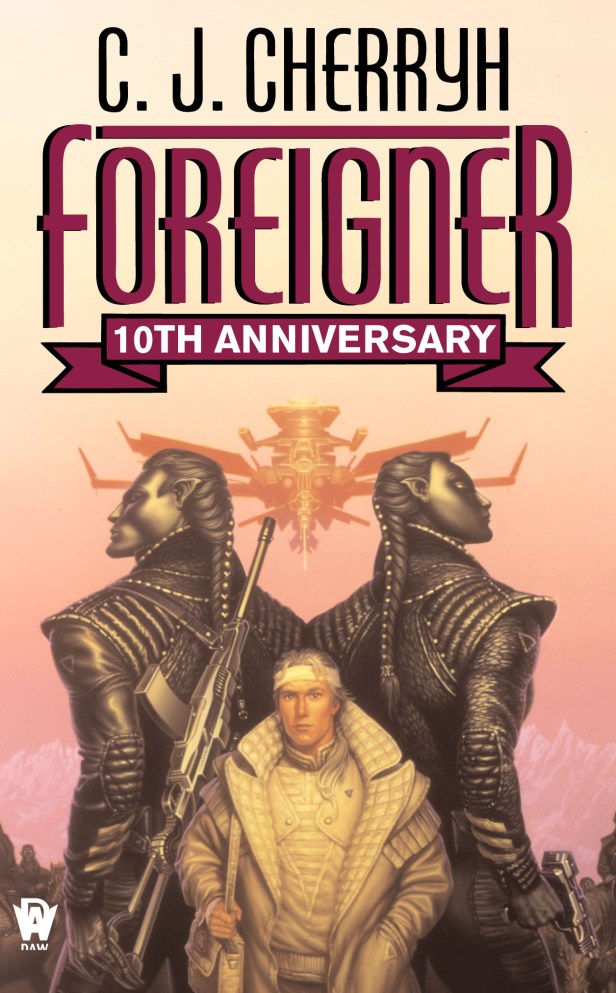
Bren Cameron serves as the human interpreter and diplomat among the atevi, a species whose social relationships cannot safely be understood through human ideas of affection and friendship.
His work demands constant attention to language, political allegiance, and the meaning of behavior. Knowing the vocabulary does not guarantee that he understands the relationship behind an exchange.
Cherryh makes this uncertainty the engine of the story. Bren must act while knowing that a familiar-looking gesture may invite an entirely unfamiliar interpretation.
Foreigner is particularly rewarding if you enjoy political tension and close attention to how people think. It also begins a substantial series, making it a good option for readers who want to spend more than one novel exploring a society.
Best for: Readers who enjoy intricate diplomacy, political maneuvering, and gradual cultural immersion.
4. Embassytown by China Miéville

In Embassytown, humans live beside the Ariekei, whose language requires specially adapted human Ambassadors to communicate with them. Language here is inseparable from the way the aliens experience reality.
Miéville pushes beyond the practical problem of translation. What happens when another species has a fundamentally different relationship with words, reference, and truth?
The result is a demanding novel in which communication becomes a source of political and social upheaval. Learning to speak across the divide changes the societies on both sides.
Choose this if you want the unfamiliarity to remain challenging. Part of its appeal is having to work toward understanding alongside the characters.
Best for: Readers fascinated by linguistics, strange worldbuilding, and challenging speculative ideas.
5. The Sparrow by Mary Doria Russell

After humans detect music from another world, a Jesuit expedition travels to investigate. The mission brings together scientific curiosity, religious conviction, and an understandable desire to believe that contact can be meaningful.
Russell builds the story around the dangerous distance between good intentions and real comprehension. The visitors learn, observe, and form relationships, yet still lack crucial context.
The Sparrow is especially effective at showing how partial knowledge can create confidence before it creates understanding. Affection for another culture does not make someone an expert on its institutions.
This is one of the darkest selections here, with sexual violence and severe trauma. Its questions about faith and responsibility give the cultural encounter lasting weight.
Best for: Readers seeking emotionally intense science fiction about religion, anthropology, and unintended consequences.
6. Dawn by Octavia E. Butler

Lilith Iyapo awakens aboard an Oankali spaceship after humanity’s near destruction. The aliens have preserved human survivors, but their plans for humanity’s future involve a biological exchange that raises difficult questions about consent.
Butler makes the Oankali unsettling through their priorities as much as their appearance. Their understanding of survival, intimacy, and genetic change challenges the categories Lilith relies on.
Learning about them is essential, but that knowledge does not remove the imbalance of power. Lilith must understand beings who control the conditions of her survival.
Dawn begins the Xenogenesis trilogy, also collected as Lilith’s Brood. It is an excellent choice for readers who want cultural understanding to lead to harder ethical questions.
Best for: Readers interested in alien biology, bodily autonomy, and morally complicated relationships.
7. A Woman of the Iron People by Eleanor Arnason

Human researcher Lixia explores an inhabited world, learning about its peoples through travel and her relationship with Nia, an alien woman.
Arnason gives cultural learning time to develop. Daily routines, social expectations, and individual experiences matter alongside the larger questions surrounding the human expedition.
A particular strength is the attention to differences within the alien population. Encountering one person or community does not mean that the visitors suddenly understand an entire world.
This makes the novel a natural recommendation for readers who enjoy the anthropological side of science fiction. The pleasure lies in watching knowledge become more complicated as the journey continues.
Best for: Readers who want patient exploration, cultural variety, and relationships built through shared experience.
Browse A Woman of the Iron People on Amazon.
8. Hellspark by Janet Kagan

A death on the planet Lassti draws Hellspark trader Tocohl into a mystery involving a survey team and the world’s birdlike inhabitants. Among the central questions is whether the visitors can recognize the natives’ intelligence.
Kagan connects that problem with the broader difficulty of interpreting communication. Meaning can depend on much more than spoken words, especially when observers assume their own habits are universal.
The mystery gives these questions immediate consequences. The characters’ ability to notice what they have overlooked matters to both the investigation and the planet’s future.
Hellspark is a strong pick for readers who want ideas about language and culture woven into an entertaining investigative plot.
Best for: Mystery readers interested in communication, intelligence, and cultural misunderstandings.
9. The Mote in God’s Eye by Larry Niven and Jerry Pournelle

Humanity encounters the Moties, an alien civilization whose capabilities and social organization present a complicated puzzle.
The central challenge is deciding what the visitors really know. Observation, negotiation, and apparently successful exchanges can still leave essential features of a civilization unexplained.
This is the most traditional first-contact space adventure on the list, with a stronger military and strategic emphasis than several other selections. Its appeal lies in gradually assembling a larger picture from incomplete information.
Read it when you want the investigation of an alien society to carry the tension of a high-stakes diplomatic encounter.
Best for: Readers who enjoy classic space opera, first-contact puzzles, and strategic uncertainty.
Browse The Mote in God’s Eye on Amazon.
10. The Long Way to a Small, Angry Planet by Becky Chambers

Rosemary Harper joins the multispecies crew of the Wayfarer, a ship that builds passages through space. Through life aboard the ship, readers encounter different attitudes toward relationships, identity, family, and community.
Chambers approaches cultural understanding through the everyday work of living together. Sharing space requires people to ask questions, respect boundaries, and reconsider what they assume everyone needs.
That smaller scale gives the novel its appeal. Understanding grows through meals, conversations, disagreements, and care.
For readers who want a warmer entry point into science fiction about alien societies, this is the most inviting place to begin.
Best for: Readers who enjoy found family, character-focused storytelling, and hopeful science fiction.
Browse The Long Way to a Small, Angry Planet on Amazon.
Which Book Should You Read First?
Start with The Left Hand of Darkness for a reflective classic, or The Long Way to a Small, Angry Planet for a warmer introduction. Hellspark suits readers who enjoy mysteries, while Foreigner offers an extended exploration of diplomacy.
For a more unsettling experience, choose Dawn or The Sparrow. Both ask what understanding can accomplish when power, belief, and vulnerability shape the encounter.
Which science fiction novel made you think differently about an alien culture? Share your recommendation in the comments!
Follow us on Instagram and Facebook


Discover more from Books of Brilliance
Subscribe to get the latest posts sent to your email.
