
Some books make the familiar world feel quietly impossible. A family drama develops an inexplicable supernatural element. A missing-person mystery begins to follow the logic of a dream. An ordinary routine continues even after reality has changed beyond recognition.
Slipstream is a useful term for this kind of reading experience.
Slipstream fiction is writing that unsettles our sense of reality, often combining literary fiction with elements of fantasy, science fiction, surrealism, or the uncanny. Its defining quality is a feeling of strangeness rather than a fixed set of plot devices.
The label has flexible boundaries. Understanding what it describes can help you find books that make you question the world on the page—and the assumptions you bring to it.
Where Did the Term Slipstream Come From?
Science fiction writer Bruce Sterling introduced the term in his essay “Slipstream,” published in SF Eye in July 1989. In the essay, he credited himself and his friend Richard Dorsett with coining the name.
Sterling was interested in fiction that challenged ordinary assumptions about reality while operating outside the usual expectations of commercial science fiction. His memorable description centered on writing that “simply makes you feel very strange.”
The original essay also explains that the name plays on “mainstream.” Sterling was drawing attention to books that crossed literary boundaries and could be difficult to place on bookstore shelves.
The term came after many works that help illustrate it. Older fiction can therefore be discussed as a precursor without suggesting its author belonged to a movement called slipstream.
What Makes a Book Slipstream?
There is no universally accepted checklist. However, several qualities help explain the term.
Reality Feels Unstable
A slipstream story may begin with recognizable people, places, and problems. Something then makes that familiar world harder to trust.
The disturbance might be an impossible event, a contradictory narrative, or a gradual sense that ordinary explanations no longer work. It need not involve literal magic.
Genre Expectations Become Unreliable
A novel might initially resemble a mystery, then move into surreal territory without providing the solution readers expect.
Other books combine domestic realism, speculative ideas, satire, and horror. The important question is what those combinations do to the reader’s understanding of reality.
Strange Events Carry Emotional Weight
An impossible development can make loneliness, grief, repression, or alienation tangible.
That does not mean every unusual detail has one symbolic meaning. Part of the appeal is that an event can feel emotionally recognizable while remaining difficult to explain.
Explanation May Remain Incomplete
Some slipstream stories leave their central disturbances unresolved. Others provide answers while continuing to unsettle the reader through their structure, tone, or implications.
Ambiguity is common, but confusion alone does not make a book slipstream.
Slipstream vs. Magical Realism, Fantasy, and Surrealism
These terms overlap. The distinctions below describe tendencies rather than rules that apply to every book.
| Term | General emphasis | Relationship to slipstream |
|---|---|---|
| Slipstream | Disrupting familiar ideas about reality and genre | A flexible description of an unsettling reading experience |
| Magical realism | Presenting extraordinary events within everyday life, often matter-of-factly | Can produce a similar effect, but has its own literary and cultural histories |
| Fantasy | Narratives involving the impossible or supernatural | Some fantasy unsettles reality in slipstream-like ways; other fantasy establishes a stable imagined world |
| Science fiction | Speculative ideas involving technology, science, society, or alternative conditions | Can overlap with slipstream, especially when speculation destabilizes ordinary experience |
| Surrealism | Dream logic, unexpected associations, and disruptions of rational order | A technique or aesthetic that slipstream writing may use |
| Weird fiction | Encounters with the uncanny, the inexplicable, or disturbing forms of existence | Shares an interest in strangeness, often with a stronger emphasis on dread |
A particularly useful distinction concerns explanation. Many fantasies invite readers to understand how an imagined world works. Slipstream often makes the desire for that understanding part of the discomfort.
Still, an unexplained magical event is not enough to settle a book’s classification. Tone, narrative method, and literary context matter too.
Five Books That Help Explain Slipstream Fiction
The selections below serve different purposes: one explicitly identifies itself as slipstream, others illustrate its effects, and one is an important earlier precursor. The explanations of why they fit are critical interpretations, rather than claims that every publisher uses the label.
1. Feeling Very Strange: The Slipstream Anthology, Edited by James Patrick Kelly and John Kessel
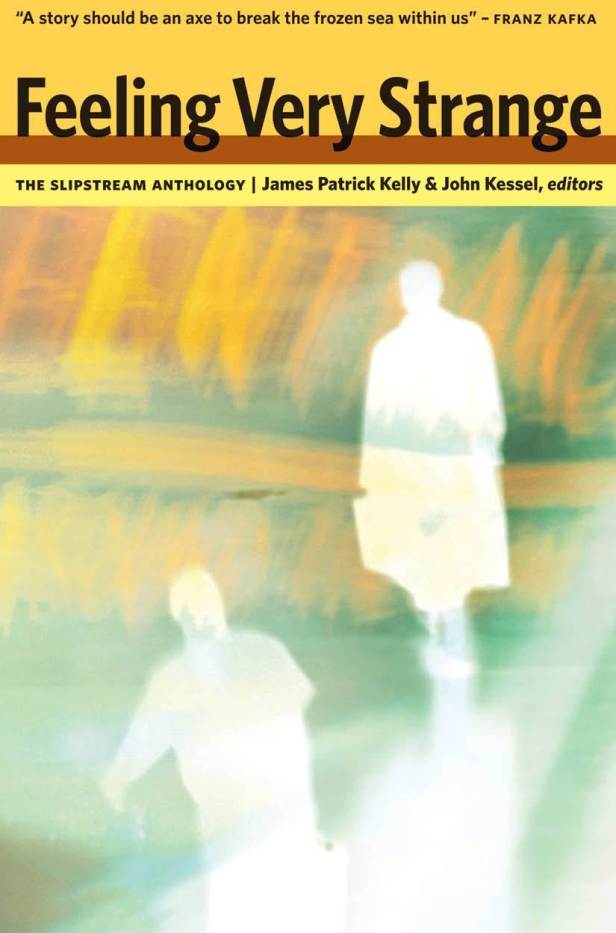
For readers who want to encounter the category directly, this anthology is a useful starting point.
Published by Tachyon, it brings together stories by writers including Karen Joy Fowler, Jonathan Lethem, Carol Emshwiller, George Saunders, and Michael Chabon. The publisher’s description emphasizes stories that challenge science fiction conventions and draw readers into surreal experiences.
Why it belongs: It explicitly explores slipstream through multiple writers, demonstrating how varied the category can be.
Best for: Readers who want to sample different approaches before committing to a novel.
2. The Wind-Up Bird Chronicle by Haruki Murakami

Toru Okada’s search for a missing cat expands into a search for his missing wife. Along the way, his apparently ordinary life opens onto disturbing encounters and buried histories.
The publisher’s synopsis presents the novel as both a detective story and an exploration of a disintegrating marriage and wartime memory.
Why it illustrates slipstream: The recognizable search narrative becomes a route into a world where psychological experience, history, and the uncanny resist clean separation.
Best for: Readers who enjoy lengthy, dreamlike novels and mysteries that expand beyond their initial questions.
3. The Memory Police by Yoko Ogawa

On an unnamed island, objects disappear, and most residents lose their ability to remember them. Those who retain their memories face persecution.
The publisher’s description establishes the novel’s central conflict: a writer attempts to protect her endangered editor as their world continues to diminish.
Why it illustrates slipstream: Its dystopian premise develops through an atmosphere of quiet unreality. The disappearances make questions about loss, identity, and control feel immediate without turning the novel into a technical explanation of its world.
Best for: Readers who prefer restrained, unsettling fiction about memory and disappearance.
For more on its atmosphere and themes, read our review of The Memory Police.
4. The Particular Sadness of Lemon Cake by Aimee Bender

Rose Edelstein discovers that she can taste the emotions of the people who prepare her food. Eating her mother’s cake reveals feelings that her family’s everyday life conceals.
That premise, outlined in the publisher’s synopsis, turns an ordinary domestic experience into unwanted intimacy.
Why it illustrates slipstream: The impossible ability unsettles the boundary between private emotion and physical experience. It also shows why slipstream and magical realism can overlap.
Best for: Readers drawn to family relationships and speculative ideas with emotional consequences.
5. The Metamorphosis by Franz Kafka

Gregor Samsa wakes to find himself transformed into a monstrous insect-like creature. His concerns about work, money, and family responsibilities persist despite his impossible condition.
The publisher’s description emphasizes the story’s combination of transformation, alienation, guilt, and absurd comedy.
Why it matters as a precursor: Kafka’s story predates the slipstream label by decades, but it makes the familiar strange with remarkable economy. Practical domestic concerns coexist with an event that defeats ordinary explanation.
Best for: Readers seeking a short classic that demonstrates how an impossible premise can expose everyday anxieties.
Where Should You Start?
Start with Feeling Very Strange if your main goal is understanding slipstream as a literary category.
For a novel focused on family emotions, try The Particular Sadness of Lemon Cake. Choose The Memory Police for a quieter atmosphere of loss, or The Wind-Up Bird Chronicle for a sprawling journey through mystery and dreamlike uncertainty.
The Metamorphosis offers a shorter introduction to the kind of estrangement that helps explain the category’s appeal.
The most useful question to ask while reading is what the strangeness changes. Does it expose something about family, memory, identity, or the stories people use to make sense of their lives?
Frequently Asked Questions
Is Slipstream a Genre?
It is often called a genre, but its boundaries are debated. It can also function as a critical label for fiction that crosses categories and destabilizes familiar reality.
Is Slipstream the Same as Magical Realism?
No. They can overlap, but magical realism has distinct literary and cultural traditions. Slipstream places particular emphasis on estrangement and unstable expectations.
Does Slipstream Fiction Have to Be Scary?
No. It can be unsettling, funny, melancholy, tender, or intellectually disorienting. Horror is one possible ingredient.
Is Slipstream the Same as Time-Slip Fiction?
No. Time-slip fiction involves movement or connections between different periods. Slipstream describes a broader literary effect and does not require time travel.
Does Every Strange Book Count as Slipstream?
No. A bizarre premise or an ambiguous ending does not automatically establish the label. How a story handles reality and genre expectations matters.
Which book has most changed your sense of what fiction can do? Share your recommendation in the comments.
Follow us on Instagram and Facebook


Discover more from Books of Brilliance
Subscribe to get the latest posts sent to your email.
