Scott Hawkins’ The Library at Mount Char is difficult to compare to anything else. It begins with a missing godlike figure, a library containing impossible knowledge and a group of adopted siblings who have been shaped—and damaged—by powers beyond ordinary human understanding. From there, it becomes a strange fusion of dark fantasy, cosmic horror, family trauma and apocalyptic mystery.
That combination is exactly why finding a true read-alike can be difficult. A novel may have secret magic but none of Hawkins’ surreal humor. Another may feature ancient gods without capturing the sense that reality itself is being rewritten. The best books like The Library at Mount Char do more than include magic: they make knowledge dangerous, power deeply unsettling and the rules of the universe feel negotiable.
The 10 books below approach that feeling from different directions. Some feature cruel schools or secret societies. Others center on living gods, impossible cities or ordinary people trapped inside worlds they cannot understand. All of them are excellent choices for readers who want another ambitious, unpredictable fantasy that refuses to behave normally.
The Best Books Like The Library at Mount Char at a Glance
| Book | Author | Best reason to read it next |
|---|---|---|
| Vita Nostra | Marina and Sergey Dyachenko | The closest match for coercive education and reality-altering knowledge |
| Middlegame | Seanan McGuire | Alchemy, gifted siblings and a plan to control the universe |
| American Elsewhere | Robert Jackson Bennett | A seemingly perfect town hiding cosmic forces |
| Kraken | China Miéville | Rival cults, bizarre magic and an approaching apocalypse |
| The Raven Tower | Ann Leckie | Gods whose words can literally reshape reality |
| The Hike | Drew Magary | A surreal and violent journey governed by inexplicable rules |
| The Book of M | Peng Shepherd | A strange catastrophe in which lost memories transform the world |
| The City We Became | N. K. Jemisin | Living cities battling an enemy from beyond reality |
| The Library of the Unwritten | A. J. Hackwith | A supernatural library, rebellious books and infernal politics |
| Piranesi | Susanna Clarke | An impossible House, hidden knowledge and an unreliable reality |
1. Vita Nostra by Marina and Sergey Dyachenko

For many readers, Vita Nostra is the best book to try immediately after The Library at Mount Char. Sasha Samokhina is coerced into attending the mysterious Institute of Special Technologies, where the lessons are incomprehensible, the instructors are threatening and failure may endanger more than the student who fails.
Like Carolyn and the other librarians raised by Father, Sasha is forced to master knowledge that changes her at a fundamental level. This is not a comforting magic-school story about discovering hidden talents. Education is invasive, frightening and transformational, and the true purpose of the school emerges only gradually.
The novel is more philosophical and claustrophobic than Hawkins’ book, but it produces the same exhilarating feeling that the reader is glimpsing a system too vast for the human mind. Choose Vita Nostra if the Library, its forbidden catalogs and the cost of learning them were your favorite parts of The Library at Mount Char.
Best for: Readers who want a dark, surreal magic school and knowledge that rewrites the self.
2. Middlegame by Seanan McGuire
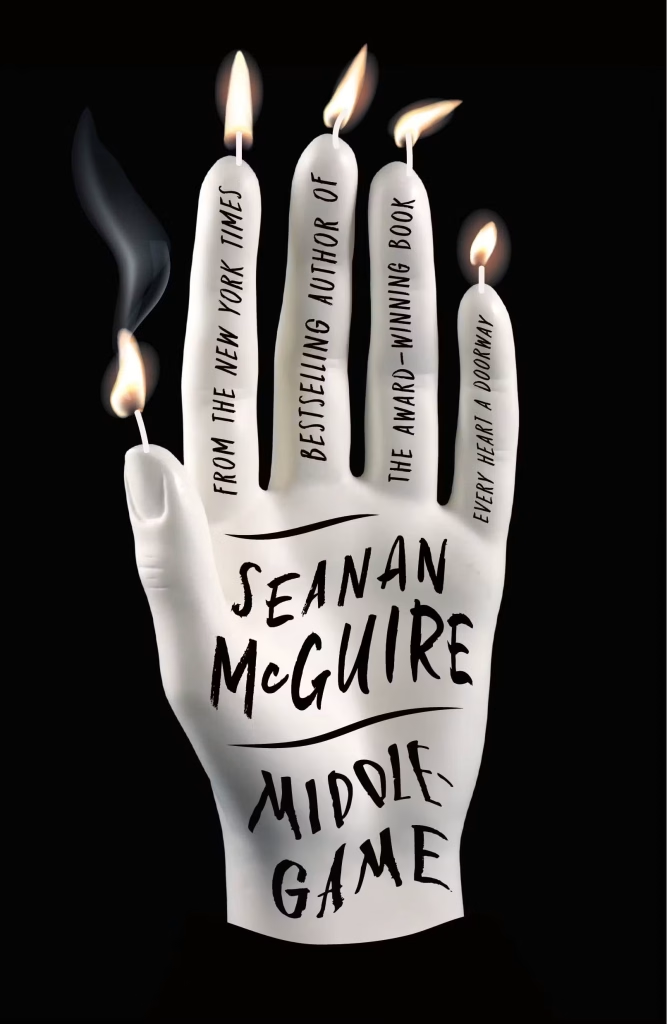
Roger understands language. Dodger understands mathematics. The gifted twins have been separated, manipulated and placed inside an alchemical experiment designed to give its creator control over reality. Unfortunately for the people controlling them, Roger and Dodger are not passive ingredients in someone else’s plan.
Middlegame shares several of The Library at Mount Char’s most compelling elements: brilliant siblings, a ruthless parental figure, hidden disciplines and power capable of remaking the world. It is also a puzzle-box novel, moving through time and slowly revealing how its apparently separate pieces fit together.
McGuire gives the central relationship more emotional warmth than Hawkins gives Father’s adopted family, but the surrounding alchemy is just as dangerous. The result is an ambitious fantasy about whether two people engineered as instruments can reclaim their own lives.
Best for: Readers drawn to damaged siblings, secret experiments and intricate reality-bending plots.
3. American Elsewhere by Robert Jackson Bennett

After inheriting a house from her late mother, Mona Bright travels to Wink, New Mexico, a town so obscure that it seems to have vanished from the map. Wink looks like an idealized piece of midcentury America, but its smiling residents obey unspoken rules—and something far older and stranger lies beneath the town’s perfect surface.
American Elsewhere begins as a mystery and steadily expands into cosmic horror. Bennett is particularly good at making the incomprehensible feel personal: the fate of entire realities matters, but so do grief, family secrets and the human desire to belong.
That balance makes the novel an excellent companion to The Library at Mount Char. Both books place damaged people at the center of enormous supernatural systems, mixing horror and wonder without losing sight of the emotional consequences.
Best for: Readers who want cosmic beings, buried family history and a seemingly normal place with impossible rules.
4. Kraken by China Miéville

When a preserved giant squid disappears from London’s Natural History Museum, curator Billy Harrow is pulled into a hidden city of competing cults, criminal magicians and supernatural factions. Some believe the missing specimen is a god. Others believe its disappearance signals the end of the world.
China Miéville fills Kraken with strange religions, bizarre magical practices and ideas that become more unsettling the longer they are considered. The novel’s London is a crowded occult ecosystem in which belief carries real power and even the apocalypse has rival interpretations.
The humor, grotesque imagination and escalating chaos make this a strong choice for readers who enjoyed how The Library at Mount Char could be horrifying in one scene and absurdly funny in the next. It is dense and deliberately weird, but that excess is part of its appeal.
Best for: Readers who want cults, urban magic, dark comedy and an unusually strange apocalypse.
5. The Raven Tower by Ann Leckie

In the kingdom of Iraden, gods are real, prayers have consequences and divine power comes with a dangerous restriction: when a god speaks, its words must be true. A false statement can force reality to change and the effort may destroy the god that uttered it.
Against this backdrop, a ruler has disappeared, a new leader has taken power and the warrior Eolo begins uncovering secrets beneath the Raven Tower. The political mystery is compelling, but the novel becomes truly distinctive through its divine narrator and its careful examination of how gods gain, use and lose power.
Readers fascinated by Father’s authority and the hidden mechanics behind the Library will find much to admire here. Leckie’s novel is more measured than Hawkins’ feverish story, yet both treat godhood as a system with rules, costs and terrifying loopholes.
Best for: Readers most interested in strange gods, divine politics and precisely defined supernatural rules.
6. The Hike by Drew Magary

Ben steps out of his hotel for a walk and discovers a path he cannot escape. His attempt to return becomes an odyssey through a hostile world populated by masked killers, giants, monsters, magic and a profanity-loving talking crab.
The premise sounds comic, and parts of The Hike are very funny, but the novel is also brutal, frightening and unexpectedly emotional. Ben survives by learning the rules of a landscape that seems arbitrary until its larger design begins to emerge.
That mixture of violence, absurdity and hidden purpose should feel familiar to admirers of The Library at Mount Char. Both novels keep changing shape while asking a central character to endure a game whose creator has withheld the instructions.
Best for: Readers who want surreal adventure, savage humor and a mystery that changes the meaning of the journey.
7. The Book of M by Peng Shepherd

People across the world begin losing their shadows. Soon afterward, they lose their memories—but the forgotten things do not simply disappear. Memory and reality become entangled, producing miraculous and horrifying changes that no one can fully control.
At the center of The Book of M are Ory and Max, a married couple trying to remain together as civilization collapses. Their intimate story gives the novel an emotional anchor while its scope grows increasingly mythic.
The magic here is less structured than Father’s catalogs, but it carries the same sense of catastrophic possibility. Human thought can change the physical world, and even beautiful transformations may have devastating costs. Readers who liked the apocalyptic stakes of Hawkins’ novel but want a more melancholy story should put this high on their list.
Best for: Readers who want an emotional apocalypse shaped by memory, sacrifice and dangerous miracles.
8. The City We Became by N. K. Jemisin

In N. K. Jemisin’s novel, great cities can become alive. New York’s awakening produces human avatars for its boroughs, but the city is immediately threatened by an invading force that wants to prevent its birth.
The premise allows Jemisin to turn identity, culture and civic conflict into cosmic fantasy. The avatars possess astonishing abilities, but they do not begin with a complete explanation of what they are. They must find one another, understand the larger battle and decide whether they can work together before the enemy consumes their city.
Like The Library at Mount Char, The City We Became combines huge metaphysical ideas with a dysfunctional group of people who have been assigned roles they did not choose. Its energy is more openly political and rooted in contemporary New York, but its personified powers and multiversal danger make it a rewarding read-alike.
Best for: Readers who want cosmic conflict, unconventional heroes and a vivid modern setting.
Buy book on Amazon
9. The Library of the Unwritten by A. J. Hackwith

In Hell, unfinished stories are kept in the Library of the Unwritten. Claire serves as its librarian, repairing books and tracking characters who escape from their manuscripts. When a retrieval mission becomes entangled with a powerful object, Claire and her companions are caught in a struggle involving Heaven, Hell and the stories humans never finished telling.
The word “library” may be the most obvious connection, but this recommendation goes beyond the setting. Hackwith imagines books as volatile objects, librarianship as a dangerous supernatural responsibility and celestial institutions as bureaucracies filled with secrets and competing agendas.
This is lighter and more adventure-driven than The Library at Mount Char, making it a useful choice for readers who want another fantastical library without quite as much brutality. The magic of stories—and the threat posed by controlling them—remains central.
Best for: Readers who want supernatural libraries, literary magic and a battle between celestial powers.
10. Piranesi by Susanna Clarke

Piranesi lives in the House, an apparently endless structure filled with statues, flooded halls and tides that move through its lower levels. He carefully records its wonders and believes he understands his world. Gradually, small contradictions suggest that both the House and Piranesi’s past contain secrets someone wants to keep hidden.
Piranesi does not match the violence or apocalyptic scale of Hawkins’ novel, but it captures something equally important: the awe of moving through an impossible place governed by concealed rules. Knowledge becomes both a source of danger and the only path toward freedom.
Susanna Clarke’s novel is quieter, shorter and more meditative than most books on this list. It is an ideal final recommendation for readers who found themselves as fascinated by the Library itself as by Carolyn’s plan.
Best for: Readers who want an impossible world, an elegant mystery and a haunting meditation on knowledge.
Which Book Should You Read First?
Start with Vita Nostra if you want the closest overall match to the experience of reading The Library at Mount Char. Its coercive education, psychological intensity and reality-changing knowledge echo the darkest aspects of Carolyn’s upbringing without feeling like an imitation.
Choose Middlegame if the damaged family dynamics and complicated plot interested you most. Pick The Raven Towerfor carefully constructed gods, American Elsewhere for cosmic horror or The Hike for a faster and more absurd journey.
Readers who primarily want another magical library should try The Library of the Unwritten, while those who want an impossible setting and a slower mystery should choose Piranesi.
Final Thoughts
What makes The Library at Mount Char memorable is not any single ingredient. Its power comes from the collision of mythology, horror, black comedy, trauma and enormous metaphysical ideas. A satisfying read-alike therefore needs more than a library or an unusual god. It needs to make the reader feel that the world is stranger, more dangerous and less stable than it appeared.
These 10 novels all create that feeling. Vita Nostra and Middlegame come closest to Hawkins’ combination of damaged students and forbidden knowledge, while American Elsewhere, Kraken and The Raven Tower offer especially strong variations on unknowable beings and dangerous divinity. Whichever path you choose, expect the rules of reality to change before the story is over.
FAQ
What genre is The Library at Mount Char?
The Library at Mount Char blends dark fantasy, horror, speculative fiction, mythology and black comedy. Its genre-crossing structure is one reason it has such a distinctive reputation.
What book is most similar to The Library at Mount Char?
Vita Nostra by Marina and Sergey Dyachenko is the closest overall recommendation because it also follows a young person forced to learn dangerous knowledge that transforms both the student and her understanding of reality.
Is The Library at Mount Char cosmic horror?
The novel contains strong cosmic-horror elements, including godlike beings, hidden structures governing reality and human characters confronting powers beyond ordinary comprehension. It also functions as dark fantasy and an apocalyptic mystery.
Are any of these books about magical libraries?
The Library of the Unwritten centers on a supernatural library in Hell, while Piranesi follows a man exploring and documenting an impossible House filled with hidden knowledge. They offer different tones but share the appeal of mysterious places that preserve dangerous secrets.
Follow us on Instagram and Facebook
Posts


Discover more from Books of Brilliance
Subscribe to get the latest posts sent to your email.